Grant-funded tech is underfunded and misunderstood.
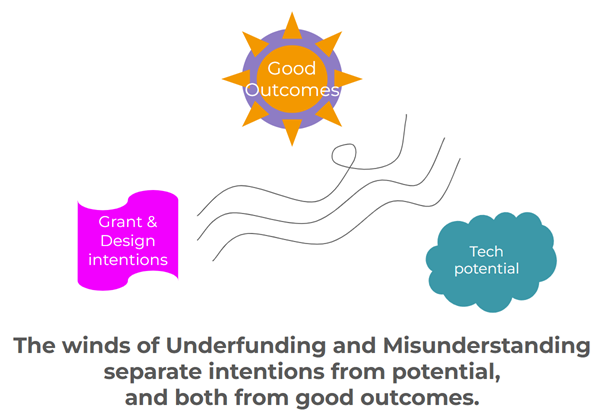
Image of the wind of underfunding and misunderstanding separating three factors: good outcomes, grant intentions and tech potential
Good outcomes for users should always be the goal - underfunding and misunderstanding between grant, design and tech can push this work apart over time even with a well-intentioned kick-off. Overloaded expectations of a small tech team can lead to conflicting priorities. An initially smart user experience can become poor over time with feature bloat. With a security incident such as a data breach, users can find the technology, made to help them, exposes them to further vulnerability.
Technology in humanitarian contexts is chronically underfunded and yet has the potential for such great heights of purpose. I can’t make a case for more funding as everything in aid is underfunded. Instead I’ll show you how we can:
Understand the consequences of underfunding and misunderstanding tech;
Learn ways to succeed despite these challenges;
Grasp the benefits of being small - namely the potential for closer, faster working;
Patchwork the skills and experience we are missing with experts.
This article is for grant writers and people who make software.
Caveat - I’m terrible at writing grants! And writing in general, it has taken me so many attempts and (di)versions to get this article together!! But I’m good at making technology. So I don’t expect anyone who is good at gaining grants and delivering social outcomes to know anything about technology, that’s why I’ve written this article. An explainer.
Technical people who make software within grant-funded environments - such as those at the ICT4D Conference this week - may relate to these issues when trying to explain technology within / to an NGO - I was there once during my time at World Vision 15 years ago and since then as an adviser, mentor and trainer to many teams including more recently AI teams in conflict settings. So this is also for you technical folk. I hear your struggles and I hope this helps you make a case for better working.
Grant-funded tech work goes adrift because of a number of assumptions, the most common I’ve seen are as follows.
7 Common Misunderstandings of Grant-funded tech projects
Once technology is built, it remains in a static state
We’re commissioning technology, not people.
The tech team will know what we need.
The tech team will work effectively towards our priorities.
The tech team will cover all necessary aspects of technology.
The tech team is expensive and this is our one shot. We must push them to get all we want.
Pro-bono / low-bono support from tech companies will fill in the gaps and (significantly) deliver the technology
In the full article, I unpack each assumption, gain understanding and learn how we can still succeed even underfunded.
We’ll then look at two other improvements for success - closer working and independent experts.
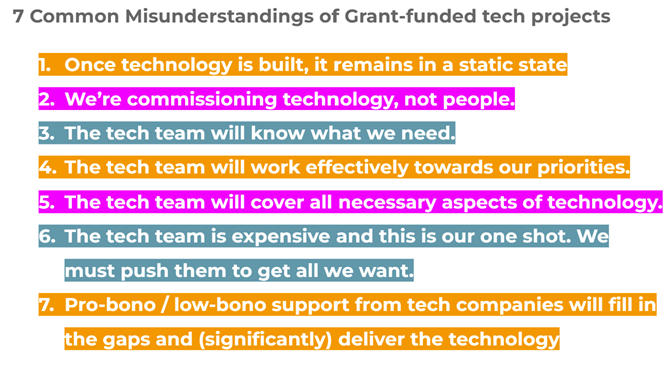
an image of the 7 common misunderstandings highlighted in bright colours