Assess & Advise
Grant-funded tech drifts off course.
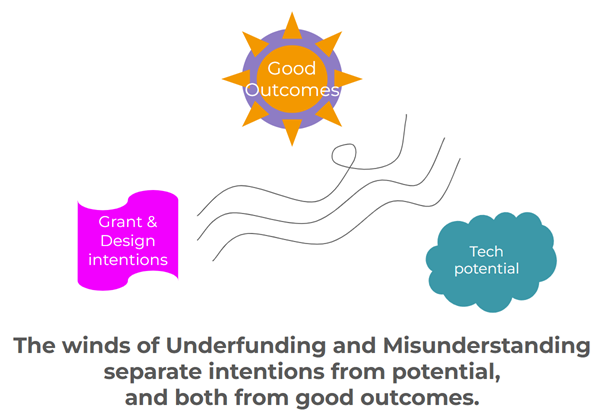
In the middle phase of a grant-funded tech programme, after the initial optimism of the design and coding kick off, many teams drift off course. Product intentions and tech potential get blown off course. The technical side may be harder than expected. The user feedback isn’t happening or isn’t good. There are new ideas and priorities start to get confused. All this pushes the work further from the goal of good user outcomes.
In my recent article explore 7 common misunderstandings which lead to this drift: Grant-funded tech is underfunded and misunderstood.
Tech & Team Assessment
-
To help solve this drift we believe you need timely, targeted advice for your most pressing issues but also mindful of the future.
We don’t do general advice, we do advice on good practice adapted to your context and budget. We aim to uncover misunderstandings; assess code and communication; and recommend clear steps for now, next and future.
We don’t blame anyone - you’ve all done the best job you could given the circumstances. We see how hard it is working in small teams.
-
We, Becky and Adam, have over 20 years of experience creating and deploying software and more recently AI or using Agentic AI for creating software. Adam is a Principal Software Engineer and Becky is a Principal Product and Delivery Manager. Becky has worked in humanitarian teams from grassroots disabilities outreach to NGO humanitarian response. In more recent years as an advisor to UN Disha and innovation programmes with StartNetwork and Creating Hope in Conflict. Together they have carried out ‘Tech & Team Assessments’ with GazaHopeWave.ai and NRC’s Kobli team.
-
You decide on the focus area(s), it could be 2 or 3 of:
a technical pressing issue such as performance, deployment readiness, code quality
a future looking area such as ‘how to get started with agentic AI’ or ‘what size team do we need after this grant finishes?’
a skills boost - how do I keep the tech team on track and not overwhelmed?
Usually issues in these areas have common overlapping causes so tackling them together from both tech and a team perspectives keeps a good balance. Becky and Adam are used to working together to find harmony among multiple objectives within a small team.
A ‘Tech and Team assessment & advisory’ is adaptable to your budget, we could achieve most of this over 2-3 weeks but at a cost of only 2-3 days of our time - approx 3,000GBP. You get a Principal Software Engineer + Principal Delivery + Product Manager tackling your most urgent or important problems you have and /or advising for the future. We won’t just base this on extract and reporting - we’ll seek to actively solve problems in conversation with tech partners and looking at code during the 2-3 weeks. We work with you to build your skills and confidence along the way so you are more prepared to carry on this work yourself sustainably.
Following assessments we are available on an ad hoc basis per hour. You may wish to buy a bucket of 5 or more hours and draw on our expertise as and when needed on your journey.
Get in touch for a quick exploratory conversation then you can decide if this is for you.

Heyam, Gaza Hope Wave, Project Director
"I want to express my sincere thanks and appreciation to you and the team for your continued effort and support. The [report] reached me at exactly the right time and will be extremely helpful in my upcoming conversations with audiences [of] Gaza Hope Wave/HopeScan."
Photo by Spark Gaza
Case study

The Gaza Hope Wave team is a group of Palestinians- AI Engineers, Community Innovation Pioneers and Health Data Experts. They gained funding from Creating Hope in Conflict (UK Aid + Canada Grand Challenges) and trained their breast cancer AI on 22,000 mammograms from Palestinian women. Midway through Proof of Concept stage they were in need of support to assess readiness for trial deployments in health clinics and gaining funds to scale.
Becky: "I could see that the 2 hours of funded mentoring wouldn't be enough. Aurora and Adam responded to my call for volunteers.
“Together we carried out a short Service Assessment as a means of internal reflection, short term fixes and longer term strategic questions."
Given the constraints towards the end of the assessment, notably the assault on Gaza City early October 2025, the assessment report was delivered as a document rather than as an interactive session.